When mobile money means business

Beyonic by Mike Koch
Dan and Luke working with One Acre Fund in Uganda. Photo by Michael Koch

I recently interviewed the founders of Ugandan fintech venture Beyonic, a finalist at this year’s Sankalp Africa Awards for sustainable enterprises. Launched in 2013, they aim to eliminate dependency on cash by helping businesses quickly set up and manage mobile money payments.

Cash doesn’t allow people to become part of the formal economy; it’s also insecure and costly, explained cofounder Luke Kyohere. And while mobile money for person-to-person payments has massively taken off, businesses have yet to exploit their full potential. That’s where Beyonic comes in: making it easy for a business to pay people using existing mobile money systems. They’ve landed some big clients (including Save the Children), but also another social enterprise, Educate!. For them, paying wages and expenses with cash meant time and money spent on travel to/from Kampala, plus risk of muggings and holding huge amounts of cash on site. Educate!, when I met them in Uganda, said getting mobile payment systems in place is one of the things that’s helping them scale up.

Read more from Luke and his American cofounder Dan Kleinbaum below. Extracts of this interview were featured in this Pioneers Post article, What the world needs to know about African enterpriseContinue reading “When mobile money means business”

Trust me, I’m a microentrepreneur

22252793264_a250461552_m
A bit less public than Tripadvisor

The age of the public review prompts some extreme behaviour – like the hotel that got ridiculed for charging £100 for posting bad reviews on Tripadvisor.

But it’s not surprising that the hotel management took Tripadvisor so seriously. Public ratings matter (and it’s worldwide: travelling in Uganda last year, every place we stayed at asked us to write them a review).

Customer feedback carries even more weight in the sharing economy, where services and resources offered by fellow citizens aren’t guaranteed by industry standards and where getting a refund is difficult, awkward or impossible. And it’s unbalanced: one bad review can outweigh ten good ones. Negative feedback can ruin the reputation and even livelihood, of the driver, DIY-helper, graphic designer, dog-walker – anyone who has decided to make their living as a microentrepeneur. Continue reading “Trust me, I’m a microentrepreneur”

Hard-working networks

6952697520_7fa1206394_z
The original networking site

I’ve been doing some writing for the European Commission’s EURES website, which aims to encourage jobseekers to take up opportunities in other countries. The blog posts are for the (somewhat oddly-named) Drop’pin blog, which targets 16-30 year-olds in EU and neighbouring countries.

A fairly broad audience then – and, being based in the UK, the challenge is to tackle a topic in a way that’s useful not only to readers in this country.

Experience of living abroad makes you aware of things that are country-specific, though (e.g. appreciating that the charity sector isn’t necessarily as developed elsewhere). Working in international teams is perhaps the best training for writing in plain English – better leave out those dazzling turns of phrase or idioms. And language skills help too, of course – for example, getting speedy responses from a source in Berlin for a piece on accessing the creative industries.

The harder, more time-consuming part is finding the right contacts in the first place. Continue reading “Hard-working networks”

Truly enterprising

Posters
Just enough budget for posters

The bizarre and wonderful Wakaliwood is making ripples around the world.

The morning we visited the “studio” of Uganda’s homegrown action movie industry, the team was expecting a group of French and German reporters. The story has been picked up by the BBC, VICE magazine, Al Jazeera, and national Irish television. The films have a cult following, with fans in Russia, Guatemala, China. In the rehearsal space – which doubles up as a bedroom for some of the actors and storage space for props and equipment – there’s a wall with foreign names scribbled on it.

“Are these all your visitors?”, we asked.

“No”, we were told, “just the ones we ‘killed’”. Continue reading “Truly enterprising”

Back to school

Taking tea - lowres
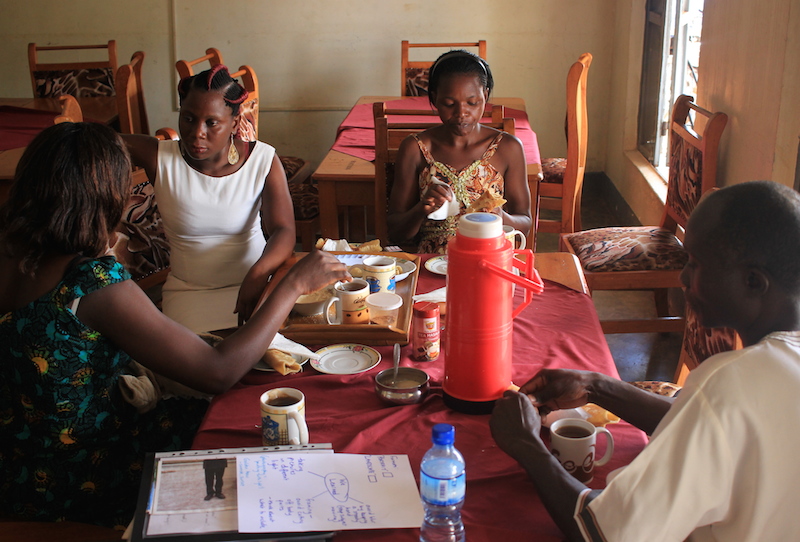
Tea break in Busembatia

I’m back in Uganda this month, and have just finished two weeks of training in the east of the country. In Busembatia, I worked with Women in Leadership (WIL) Uganda, training their four Ugandan volunteers in basic photography and computer use. WIL Uganda was started by a former lawyer from the UK, whose stint as a volunteer here last year convinced her that much more was needed to support women and girls. Cases of rape are all too frequent; many women have been abandoned by their husbands to raise children alone and without an income. Girls are often shy or reluctant to speak their minds.

One year on, and WIL Uganda’s volunteers now teach adult literacy and handcrafts to the women and lead career guidance and writing classes with the girls in one of the secondary schools. Continue reading “Back to school”

Stories of purpose

tumblr_static_7zp6wm11f5csw4owk4k8sg08wSince the spring, a team of us at On Purpose have been working on a collaborative storytelling project. A few weeks ago, we finally unveiled Humans on Purpose.

It’s not the first rip-off of the simple yet captivating Humans of New York idea – but it may well be the first to share stories of social purpose. We’ve got a pretty wide range: from CEOs and young entrepreneurs to former priests and ex-offenders. They’ve talked to us about their mums and their children; about pivotal moments and long-enduring passions; about anger and playfulness. People really are prepared to talk honestly about why they do what they do.

It’s the first time I’ve been involved in such a wide collaboration (we’ve had 50+ interviewers, 5 editors, and several people involved in the design and development of the site, plus numerous others organising the final event of the project). Here are some things I learned: Continue reading “Stories of purpose”

Plant your feet, and other storytelling tips

yourstory

Earlier this year I gathered a few VSO colleagues to join me on the Acumen+ Storytelling for Change course, which is all about bringing (personal) stories into your professional communication, helping you to connect with (and convince) your listeners as you present.

I’ve tried before, and failed, to complete online courses; free ones like these are even harder to see through. What worked this time? Mainly it was  committing to meet weekly as a group for the duration of the modules (guilt about letting other people down is stronger than the guilt of letting yourself down, it seems). But also genuine enthusiasm within the group for the topic, and a sense that the lessons were fairly universally relevant.

Here are some of the best bits of learning for me: Continue reading “Plant your feet, and other storytelling tips”

Giving time

It was Volunteers’ Week here in the UK (as well as Women’s Sport Week, in fact – nice profile of boxer Nicola Adams here on role models). It doesn’t seem to make many headlines outside the charity sector – yet the scale of volunteer work in this country is much larger, surely, than most people realise. 15.2m people in the UK (nearly a quarter of the entire population) volunteer each month; 0f the 164,000 registered charities, an amazing 90% have no paid staff, not to mention an estimated 150,000 further, non-registered organisations, also run by volunteers.

It’s not only the actual work these people do that matters, though. It’s also how they do it, according to research recently published by VSO (my current placement): by giving time for free to help a good cause, volunteers are expressing values of solidarity and citizenship that can prompt knock-on effects on others. As a headteacher in Nepal said, according to the research, “when the volunteer came to help, the [local community] think if someone can come to help us, we can help each other”. Continue reading “Giving time”

Cross-border collaboration

Outside the Regional Centre for Accommodation and Procedures for Asylum Seekers, Bucharest

The series on youth opportunities I produced last year with Romanian TV journalist, Lorelei Mihala, is being published in instalments on Cafe Babel (appropriately, a magazine published in multiple languages and aimed at young Europeans).

We were funded by the Council of Europe, as part of a programme aimed at getting more diversity into the media – hence our focus on young migrants and refugees in both cities, London and Bucharest.

It was a difficult project. Continue reading “Cross-border collaboration”

Social enterprise: halfway to mainstream?

The UK arguably leads the world in its support for social enterprise – and is keen to position itself as such, from putting social investment high on the agenda of its G8 presidency in 2013 to inviting other nations to learn from what we’re doing.

I covered the latter – during a British Council-hosted visit for EU policy-makers – for the Guardian’s social enterprise hub last month, and heard how countries like Croatia, in the midst of finalising its own first social entrepreneurship, are hungry to learn from UK policy-makers’ 15 or so years’ experience in this area.

In this country, social enterprises employ over 2 million people (more than the financial and insurance industries combined!) and contribute at least £55bn to the economy; this is also birthplace of the world’s first social impact bond, an innovation that’s spreading slowly further afield. Continue reading “Social enterprise: halfway to mainstream?”